
If you are new to investing, understanding Index Funds vs ETFs is crucial for building a strong portfolio. While both options offer low-cost ways to track the market and grow your wealth, they differ in trading flexibility, minimum investments, and tax efficiency. Comparing Index Funds vs ETFs helps beginners choose the right investment strategy that fits their financial goals and risk tolerance.
You have decided to begin investing. Good for you! And then you opened up an app or looked through an article and saw these two terms: index funds and ETFs. Now what? Which one should you choose? Do they even matter?
They do slightly, but not by much. Index funds and ETFs are both pretty much the exact same thing: cheap and easy ways for you to grow your wealth. In this article, I will explain the differences between ETFs and Index Funds, in simple language, so you can stop stressing and start investing.
What Is an Index Fund, Really?
When comparing Index Funds vs ETFs, think of an index fund as a basket. Instead of buying shares of individual companies and hoping they do well, you’re buying tiny portions of many different companies at once. An index fund is a type of mutual fund that tracks an index, such as the S&P 500, so that you can buy small amounts of every stock within that index with one purchase.
You don’t pick individual stocks in an index fund. You just pick a stock market index, and then let the fund manage itself. This makes index funds a kind of “passive” investment, since you don’t have to do as much work to make sure your money is growing. As Fidelity puts it, index funds “seek to track the performance of a market index … [and] this approach tends to result in lower expenses.”
You can buy index funds from a number of sources, including Vanguard and Fidelity, and sometimes as part of a 401(k) retirement plan. The share price of these funds is based on how much the market was worth that day, and they’re only bought or sold after the market has closed for the day.
What Is an ETF, Really?
An ETF is an exchange-traded fund. The important distinction to make here is that an ETF is not a competitor to an index fund, but rather a variation of one.
Many ETFs track an index, such as the S&P 500. The main difference between an index mutual fund and an ETF is in how they are traded. An ETF can be bought and sold on the stock market throughout the day. So, if I wanted to, I could buy an ETF at 10 a.m. and sell it at 2 p.m. The price of an ETF will fluctuate during the day, just like a stock.
So here’s the simple way to remember it: index funds describe what a fund invests in , while ETFs and mutual funds describe how a fund is bought, sold, and organized. An index fund can be constructed as an ETF. Sounds complicated, but it really isn’t once you think about it.
The Real Differences Between Index Funds and ETFs
Let’s cut through the noise. Here’s what actually changes depending on which one you pick.
1. When You Can Trade
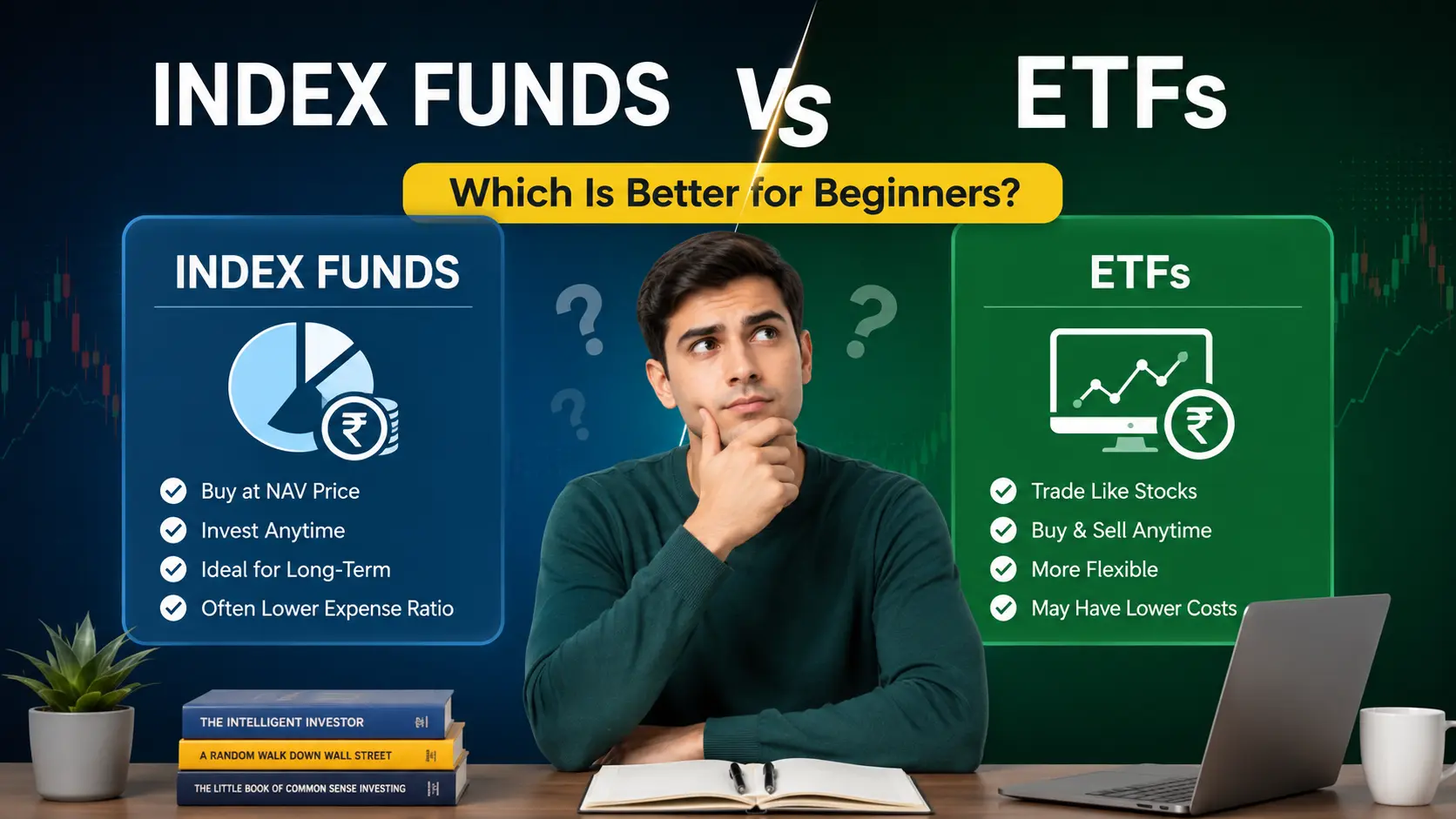
Index funds are priced once per day, at the closing of the market. An ETF is priced throughout the day, like a stock. It makes no difference to long-term investors, but if you like to watch your investments’ values fluctuate throughout the day, you’ll feel more at home with an ETF.
2. How Much Money You Need to Start
ETFs typically have a much lower entry cost since you can buy them at the price of one share. Many brokerage companies also allow you to buy fractional shares, which means that you can start with only a couple of dollars. Index funds, on the other hand, sometimes have a minimum investment, which can be several hundreds or thousands of dollars, depending on the fund’s company.
3. Taxes
This one is subtle but important – ETFs are generally more tax-efficient than index mutual funds. That means you’ll likely pay less in capital gains taxes each year. According to NerdWallet, “many ETFs are more tax-efficient than index mutual funds.” However, if you’re using a 401(k) or another tax-advantaged account, it doesn’t really matter. Your money will either be subject to taxes when you take the money out as income or not taxed at all.
4. Fees
Both are typically far cheaper than active mutual funds, where the portfolio is managed by a fund manager. Expense ratios on exchange-traded funds (ETF) and index funds have been near record lows in recent years, according to the Investment Company Institute. However, you should still compare expenses. The difference between an ETF that charges 0.03% a year and one that charges 0.75% could be enormous.
So, Which One Is Better for Beginners?
Honestly? Neither one wins by a landslide. Here’s a simple way to think about it.
Pick an ETF if you want to start with a smaller amount of money, you like the idea of being able to buy and sell your shares throughout the day, or you want the tax advantages of investing in a taxable account.
Pick an index fund if:
You are going to invest through your 401k at work anyway,you want to be able to put money in automatically every month without thinking about it,or you just like the idea of being able to buy and forget it and only buy once a day
Many long-term investors end up using both, depending on the account. That’s completely normal, and it’s not a sign you’re doing something wrong.
A Simple Rule to Remember
If you can’t decide, just start. You can’t go wrong by picking a simple low-cost fund or an ETF that tracks an established index like the S&P 500. The bigger danger by far is sitting on the sidelines for another two years, trying to pick the perfect fund when your money could be earning next to nothing in a savings account.
Frequently Asked Questions
Is an index fund the same thing as an ETF?
Not precisely. An index fund is an investment that tracks the performance of a market index. An ETF is an exchange-traded product that is traded like a stock. An index fund can take the form of an ETF; thus, many people do not distinguish between the two.
Which is cheaper, index funds or ETFs?
Both can be very cheap. Compare the expense ratio of the specific fund you’re looking at rather than assuming one category always wins.
Can I lose money in an index fund or ETF?
Yes. Both are tied to the stock market, which means they can rise or fall in value depending on how the market does. Over the long term, funds that track a broad market index tend to increase in value, but they can also decrease, especially in the short term.
Do I need a lot of money to start?
No. Many ETFs let you start with the price of one share, and fractional shares make it possible to start with just a few dollars at many brokers.
Helpful Resources to Learn More
- Fidelity: ETF vs. Index Fund: https://www.fidelity.com/learning-center/smart-money/etf-vs-index-fund
- NerdWallet: ETF vs. Index Fund, The Key Differences: https://www.nerdwallet.com/investing/learn/etf-vs-index-fund-compare
- Navy Federal: Differences Between ETFs, Mutual Funds and Index Funds: https://www.navyfederal.org/makingcents/investing/etf-vs-mutual-fund-vs-index-fund.html
This article is for general education only and isn’t personalized financial advice. Talk to a licensed financial advisor before making investment decisions.