
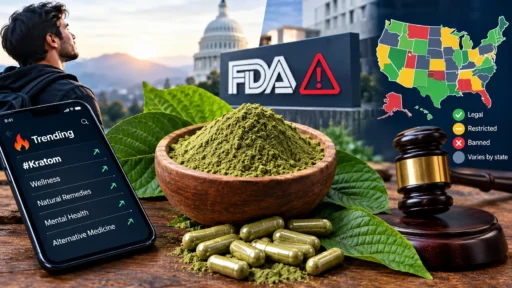
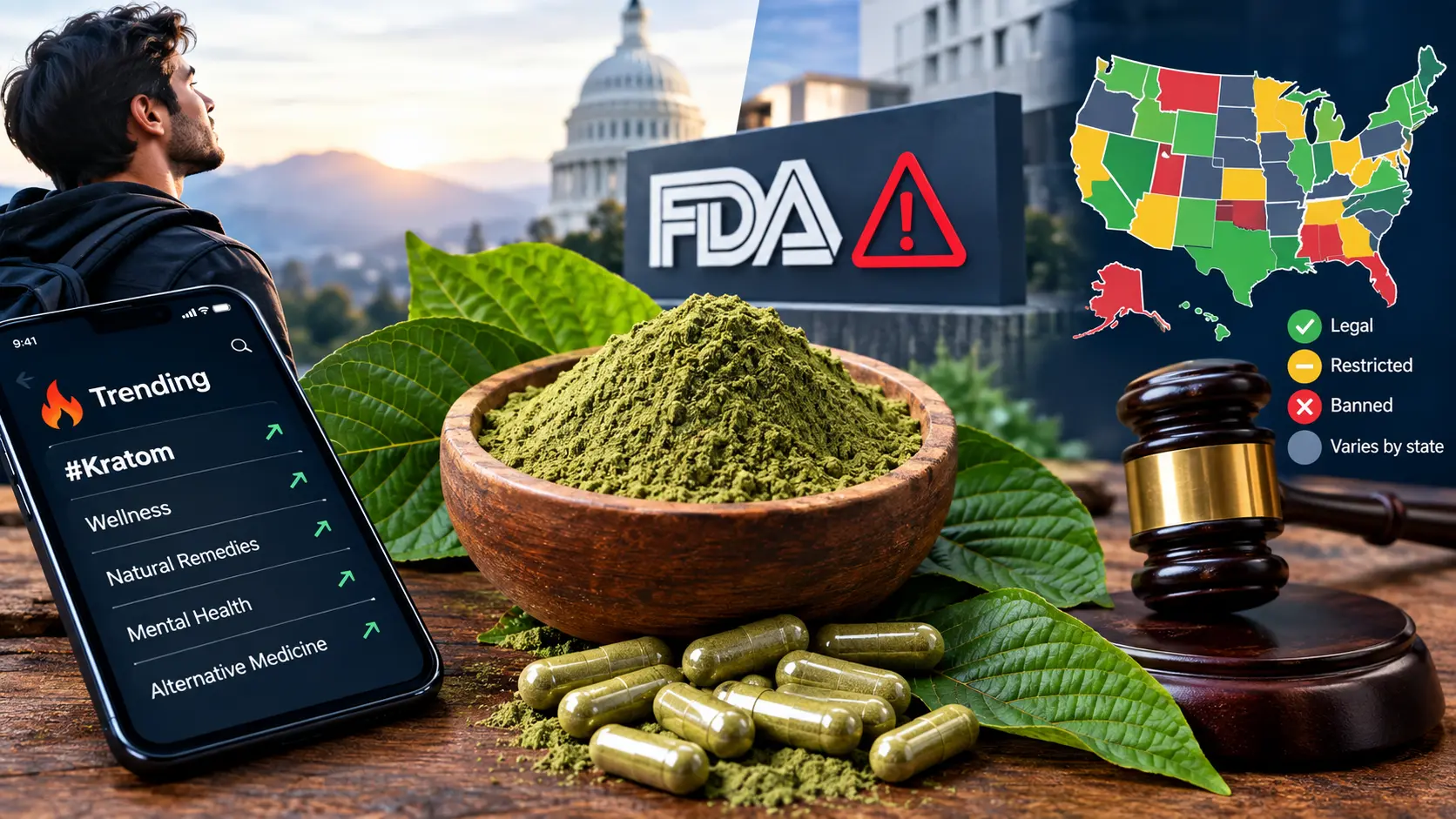

Why is Kratom Trending 2026 across the United States? Kratom has rapidly gone from a niche herbal product to a shelf staple at petrol stations, vape shops, and online stores. If you’ve noticed the shots, capsules, and gummies popping up everywhere and wondered what’s going on, you’re not alone. Here’s what’s actually driving the trend, and what regulators are doing about it.
Quick Answer
Kratom has become popular as a cheap legal alternative to energy drinks and opioids, making its concentrated extracts and 7-hydroxymitragynine (7-OH) concentrates available at convenience stores and online. The FDA has warned several times that kratom may cause liver injury, seizures, and dependence — and has not approved of any medical uses of the substance. As of September 2026, ten US states have banned it, more than twenty monitor it under the Kratom Consumer Protection Act (KCPA), and the DEA has begun the formal process of scheduling concentrated 7-OH as a controlled substance.
What Is Kratom, Exactly?
Kratom is a substance derived from the leaves of a tropical tree known as Mitragyna speciosa, mostly found in Southeast Asia. For centuries, people have been chewing or brewing the leaves as traditional medicine in Thailand, Indonesia, and Malaysia. The leaves are sold as powders, capsules, teas, and lately, in the US, there has been an increase in shots and gummies. The active components in Kratom are Mitragynine and 7-hydroxymitragynine (7-OH), which are opioid agonists that mainly target the opioid receptors in the brain.
Why Is Kratom Trending Right Now?
A few things are converging at once:
- Convenience-store expansion: kratom shots and 7-OH drinks are now sold on the counter at petrol stations and smoke shops, next to energy drinks, where they stand out much more prominently than the old-style powder tubs.
- Marketed as an opioid alternative: some sellers are promoting it as a pain reliever or opiate withdrawal aid, even though it has not been approved for any medical use.
- Social media buzz: products are being discussed on TikTok and in Reddit “hollowing” communities, fueling interest among younger consumers.
- Concentrated 7-OH products: newer, more potent extracts have driven an explosion in sales – and regulatory scrutiny.
What Has the FDA Warned About Kratom?
The FDA has never approved kratom, or any of its alkaloids, as a drug, supplement, or food ingredient. The agency has repeated its warning that people should not use kratom, pointing to a pattern of adverse event reports. It’s worth knowing what’s specifically been flagged:
| Risk flagged by the FDA | What’s been reported |
| Liver toxicity | Raised liver enzymes and, in some cases, acute liver injury needing treatment. |
| Seizures | Convulsions are among the most commonly reported adverse events tied to kratom. |
| Substance use disorder | Regular users can develop dependence and withdrawal symptoms similar to opioid withdrawal. |
| Contamination | Salmonella and heavy-metal contamination have triggered multi-state outbreaks and recalls. |
| Newborn withdrawal | Babies born to mothers who used kratom in pregnancy have shown jitteriness and muscle stiffness. |
Separately, the FDA has issued warning letters to companies illegally marketing 7-OH tablets, gummies, and drink mixes with unproven claims about treating pain or opioid withdrawal. In late 2025, federal agencies seized roughly $1 million worth of unlawful 7-OH products from firms in Missouri.
Is Kratom Legal in Your State?
Kratom is legal at the federal level, but state law is where it gets complicated, and it changes often. Here’s the current landscape:
| Status | What it means | Example states |
| Fully banned | Possession, sale, or manufacture is a criminal offence. | Alabama, Arkansas, Indiana, Louisiana, Vermont, Wisconsin, Tennessee (from July 2026) |
| Regulated (KCPA) | Legal for adults, usually 18-21+, with lab testing, labelling, and purity rules. | Georgia, Utah, Arizona, Nevada, Oklahoma, Texas, Virginia, West Virginia |
| Legal, no specific law | No state statute either way; general consumer law applies. | Pennsylvania, Washington, South Dakota, Wyoming |
| Local bans within legal states | City or county ordinances override state-level legality. | Sarasota County (Florida), San Diego and Oceanside (California), parts of Mississippi |
Rhode Island repealed its ban on 1 April 2026 – and became the first US state to reverse the prohibition and start regulating kratom according to KCPA-style laws. Tennessee’s ban comes into force on 1 July 2026. However, California has enforced restrictions on the sale of kratom and 7-OH by the state’s health authorities – and not through a single act of the legislature. It is always necessary to check the laws in your state and city before ordering, transporting, or growing kratom. Local ordinances may actually be stricter than statewide law.
What’s Happening with 7-OH and the DEA?
On 1 July 2026, the DEA opened the process of temporarily scheduling concentrated 7-OH and 3 related synthetic compounds under the Controlled Substances Act. This does not relate to the leaf itself but to high concentrated extracts and synthetic derivatives. The Department of Health and Human Services initiated a 30-day public comment period on the proposed threshold. Three related compounds were formally scheduled by the end of August 2026, while the status of concentrated 7-OH itself is still under review as regulators strive to differentiate between high concentration extracts and regular leaf products.
Should You Be Concerned?
If you use Kratom or are considering using it, the prudent thing to do would be to act responsibly as you would with any grey-market substance, which means reviewing your state and local laws, avoiding high concentration 7-OH products that may contain legal opioids, and consulting a medical professional before mixing it with other drugs like opioids or benzodiazepines or consuming it with alcohol. If you’re a regular user, talk to your doctor about it and consider undergoing a liver panel test, as the FDA has issued several toxicity warnings in the past.
Frequently Asked Questions
Is kratom an opioid?
Not technically, but its main compounds bind to the same opioid receptors in the brain, which is why it can produce opioid-like effects and carries similar dependence risks.
Why is kratom suddenly everywhere in gas stations?
Retailers have started stocking concentrated kratom shots and 7-OH drinks alongside energy drinks because demand has grown quickly and, in most states, these products don’t require a prescription or age-restricted licensing beyond standard ID checks.
Has the FDA banned kratom nationwide?
No. The FDA has warned consumers against using kratom and has taken enforcement action against companies making illegal health claims, but there is no federal ban on the kratom leaf itself. The DEA is currently working to schedule concentrated 7-OH specifically.
Which states have banned kratom?
As of September 2026, roughly ten states prohibit kratom outright, including Alabama, Arkansas, Indiana, Louisiana, Vermont, Wisconsin, and Tennessee. Always confirm your specific state, since laws are changing through 2026 and 2027.
What is the Kratom Consumer Protection Act (KCPA)?
It’s model legislation, backed by the American Kratom Association, that regulates rather than bans kratom. Typical KCPA rules include a minimum purchase age (usually 21), mandatory lab testing, accurate labelling of mitragynine content, and bans on marketing to minors.
Is 7-OH the same as regular kratom?
No. 7-OH (7-hydroxymitragynine) occurs naturally in the kratom plant only in trace amounts. The products raising concern are concentrated or synthetic versions of 7-OH, which are far more potent than the leaf itself.
The Bottom Line
What is behind Kratom boom in 2026? Easy availability, active selling of concentrates, and increased interest on social media have contributed to the popularity of kratom. The topic is now actively discussed in the US Senate and among the states; the FDA warnings have not changed, but the kratom control and regulation have begun. Before buying this substance, check the laws in your state and the label on the package; if you use it often, consult your doctor.