
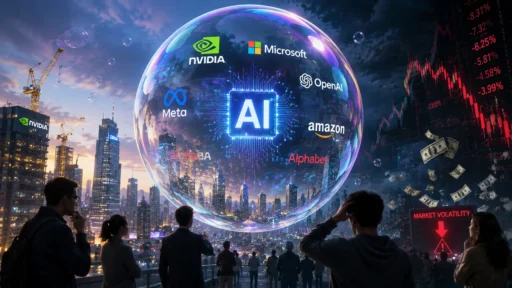
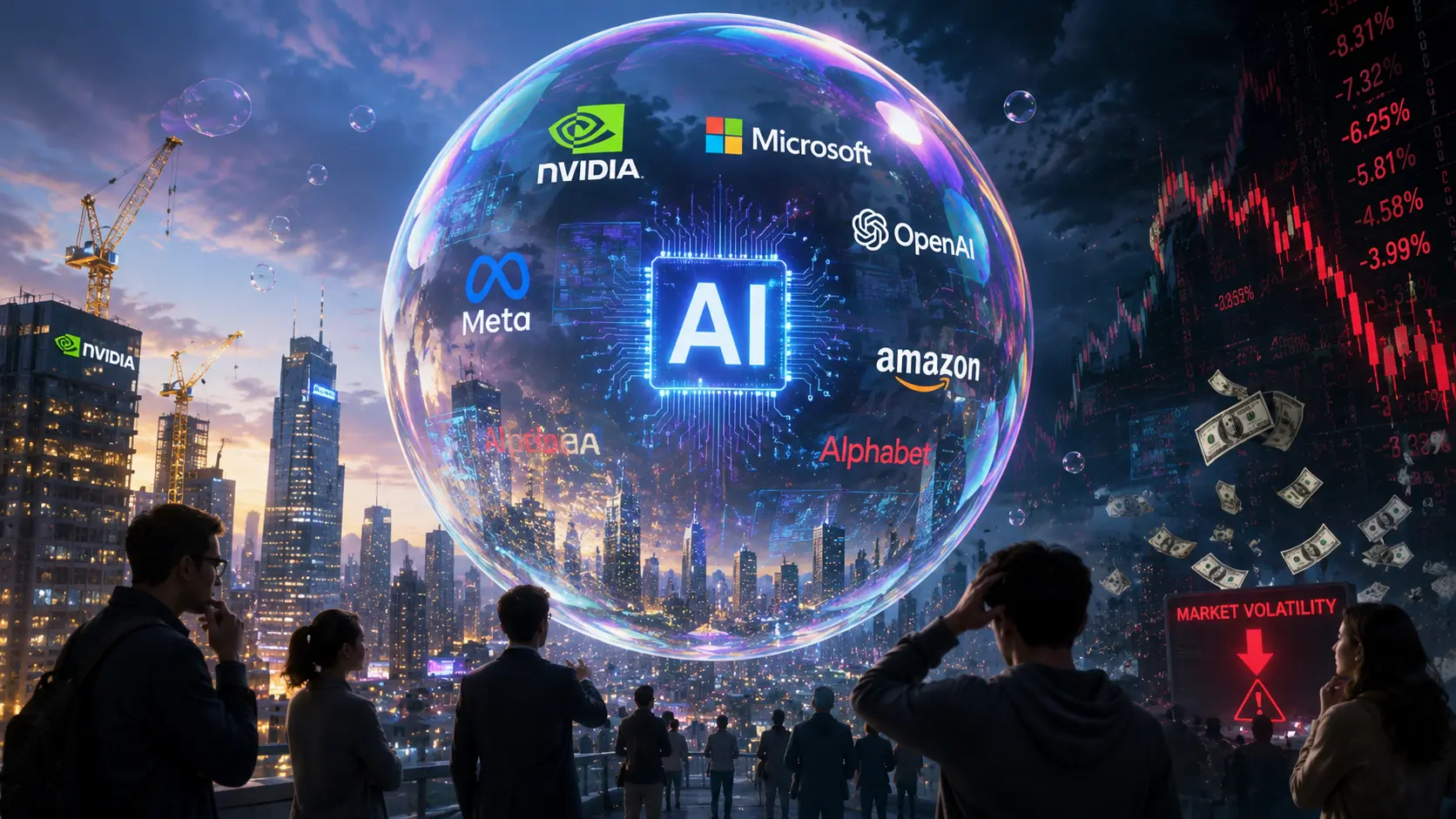

Is the AI Boom a bubble, and is it going to pop soon? While many investors are worried about a sudden market crash, others believe this rapid growth is just getting started. Let’s break down what is really happening in plain English, no finance degree needed.
First, What Even Is a “Bubble”?
A bubble happens when the price of something — stocks, houses, even Beanie Babies back in the day — shoots up way higher than what it’s actually worth. People keep buying because prices keep going up, not because the thing itself is worth that much. Eventually, reality catches up, prices crash, and a lot of people lose money fast.
The most famous tech example is the dot-com bubble of the late 1990s. Companies with barely any customers or income were worth billions, just because they had “.com” in their name. When the bubble popped in 2000, trillions of dollars vanished almost overnight.
Why Some People Think AI Is Heading the Same Way
Big tech companies are spending an enormous amount of money on AI. Microsoft, Amazon, Google, and Meta together are expected to spend somewhere around $650 to $760 billion on AI infrastructure in 2026 alone — think data centers, computer chips, and power plants to run it all. That’s more money than most countries spend on their entire military each year.
Some of that spending is being funded with borrowed money, not just company profits. Tech companies issued over $108 billion in corporate bonds in a single recent quarter, according to Moody’s Analytics. Chief economist Mark Zandi called it “a lot of debt, and a lot of it all of a sudden.” Borrowing that much to fund a technology that hasn’t fully proven its payoff yet is exactly the kind of thing that worries economists.
Billionaire investor Ray Dalio has said AI is already in the “early stages of a bubble.” Even OpenAI’s own CEO, Sam Altman, admitted last year that investors might be getting “overexcited about AI.” When the person building the technology says that, it’s worth paying attention.
Why Other Experts Say This Time Is Different
Here’s the twist: unlike most dot-com companies, today’s biggest AI players are actually making serious money. Nvidia reported more than $120 billion in profit for its fiscal 2026. Microsoft’s cloud and AI business grew profits and revenue at the same time. Amazon Web Services just posted its fastest growth in 18 quarters.
That’s a big deal, because a real bubble usually involves companies with big dreams and empty wallets. Right now, the companies leading the AI rally are among the most profitable businesses that have ever existed. Their stock prices are expensive, sure, but they’re backed by actual cash coming in the door, not just excitement.
AI Boom vs. Dot-Com Bubble: The Real Difference
Think of it this way: back in 2000, tech companies were like a restaurant with no customers, charging investors for the promise of a five-star menu someday. Today’s AI giants are more like a restaurant that’s already packed every night, but is spending a fortune building five new locations before it knows if demand will hold up everywhere.
Stock prices for AI companies are high, but not as extreme as they were in 2000. Comparing similar measures, the tech sector’s average price relative to earnings is roughly 30 today, versus around 50 to 60 at the peak of the dot-com era. That’s still pricey. It’s just not quite as wild as last time.
What Could Actually Pop the Bubble?
Most experts agree on two realistic triggers. The first is interest rates. If borrowing money gets a lot more expensive, all that debt-funded AI spending becomes harder to justify, and investors could panic. The second is monetization — plain talk for “actually making money off the thing.” If companies keep spending hundreds of billions on AI but customers don’t pay enough to make it worthwhile, investors will eventually lose patience.
There’s already been a preview of what that panic looks like. In June 2026, weak guidance from a major chipmaker sent AI and cloud stocks tumbling in a single trading session, with traders suddenly questioning whether sky-high valuations still made sense without the promise of lower interest rates.
What This Means for You
Even if you’ve never bought a single stock, this still touches your life. If you have a 401(k), an index fund, or a retirement account through work, there’s a good chance you already own AI-related stocks, since companies like Nvidia, Microsoft, and Amazon make up a huge chunk of the overall stock market.
That doesn’t mean you should panic or pull your money out. It just means it’s smart to know what you own. A few simple habits help here: don’t put all your money into one hot trend, check that your investments are spread across different industries, and try not to make big decisions based on daily headlines. Bubbles, if they happen, usually take time to fully play out.
So, Is It a Bubble or Not?
Honestly, the fairest answer is: parts of it look like a bubble, and parts of it don’t. The spending is enormous and some of it is funded by debt, which is a real warning sign. At the same time, the companies involved are genuinely profitable in a way dot-com companies never were, which is a real reason for confidence.
The AI technology itself is probably here to stay. Whether every company currently riding the hype survives at today’s stock prices is a completely separate question. That’s the part nobody, not even the experts, can answer for certain yet.
Frequently Asked Questions
Is AI really in a bubble right now?
There’s no single right answer. Some experts, like Ray Dalio, say AI investing is already showing early bubble signs. Others, like top analysts at Goldman Sachs, say the spending is backed by real revenue and real profits, so it’s not the same as past bubbles.
What would cause the AI bubble to burst?
Most experts point to two triggers: interest rates rising sharply, which makes borrowed money more expensive, or AI companies failing to turn their huge spending into real profits fast enough to satisfy investors.
Is it safe to invest in AI stocks in 2026?
This isn’t financial advice, but it’s worth knowing that AI stock prices are already assuming a lot of future growth. If that growth slows down, prices could fall hard. Spreading your money across different investments is generally safer than betting everything on one trend.
How is the AI boom different from the dot-com bubble?
The biggest difference is profit. Many dot-com companies had little to no revenue. Today’s leading AI companies, like Nvidia, Microsoft, and Amazon, are some of the most profitable companies in history, even though their stock prices are still expensive.
Should regular people worry about an AI bubble?
If you have a 401(k) or index fund, you likely already own AI stocks, since they make up a large part of the market. It’s worth knowing this, mainly so a possible downturn doesn’t catch you off guard.